Dress This House
Bringing fashion sense to bear on a Freo worker’s cottage renovation.
ARCHITECTURAL DESIGN CLARE MENGLER INTERIORS ELIZABETH CLARKE LANDSCAPE DESIGN ZERASCAPES
BUILDER GLEN WARLOCK CONSTRUCTION SERVICES WORDS ELIZABETH CLARKE IMAGERY JODY D’ARCY

As an interiors writer and former fashion editor, I’ve always seen a strong correlation between the two worlds. Both rely on juxtaposition – the tension between the new and the old, the classic and the edgy. So, when it came to designing my own home, a 1900s limestone worker’s cottage in South Fremantle, I didn’t have formal interiors training, but I did have an approach: design like I dress.
First, though, came the renovation – and the rediscovery of a house with remarkable bones beneath the chaos. When my partner, Brett Renouf, found it, the cottage was in disrepair with a rat problem and former feline resident that couldn’t let go. Yet we could see so much promise: lofty ceilings, a generous central corridor, and honey-toned hardwood floors. The previous owners had “Italianised” it over time, replacing its Federation details with Art Deco detailing and Roman columns. At the rear sat a 1970s lean-to wrapped in an ugly array of mosaic tiles.
I bought the cottage just as the pandemic arrived, swiftly evicted its resident creatures and moved in. The front room became my office and bedroom, the others my children’s. Then Brett and I began the painstaking restoration ourselves. We reinstated ceiling roses and architraves, sanded and oiled the floors, hung linen curtains and polished brass fittings. A floor-to-ceiling bookcase framed the heart of the house, while Kartell pendants and reeded glass introduced a modern, luminous note. Living through it all – the dust, the noise, the endless decisions – was unbelievably testing at times, especially cooking from a makeshift kitchen on the front veranda during winter.
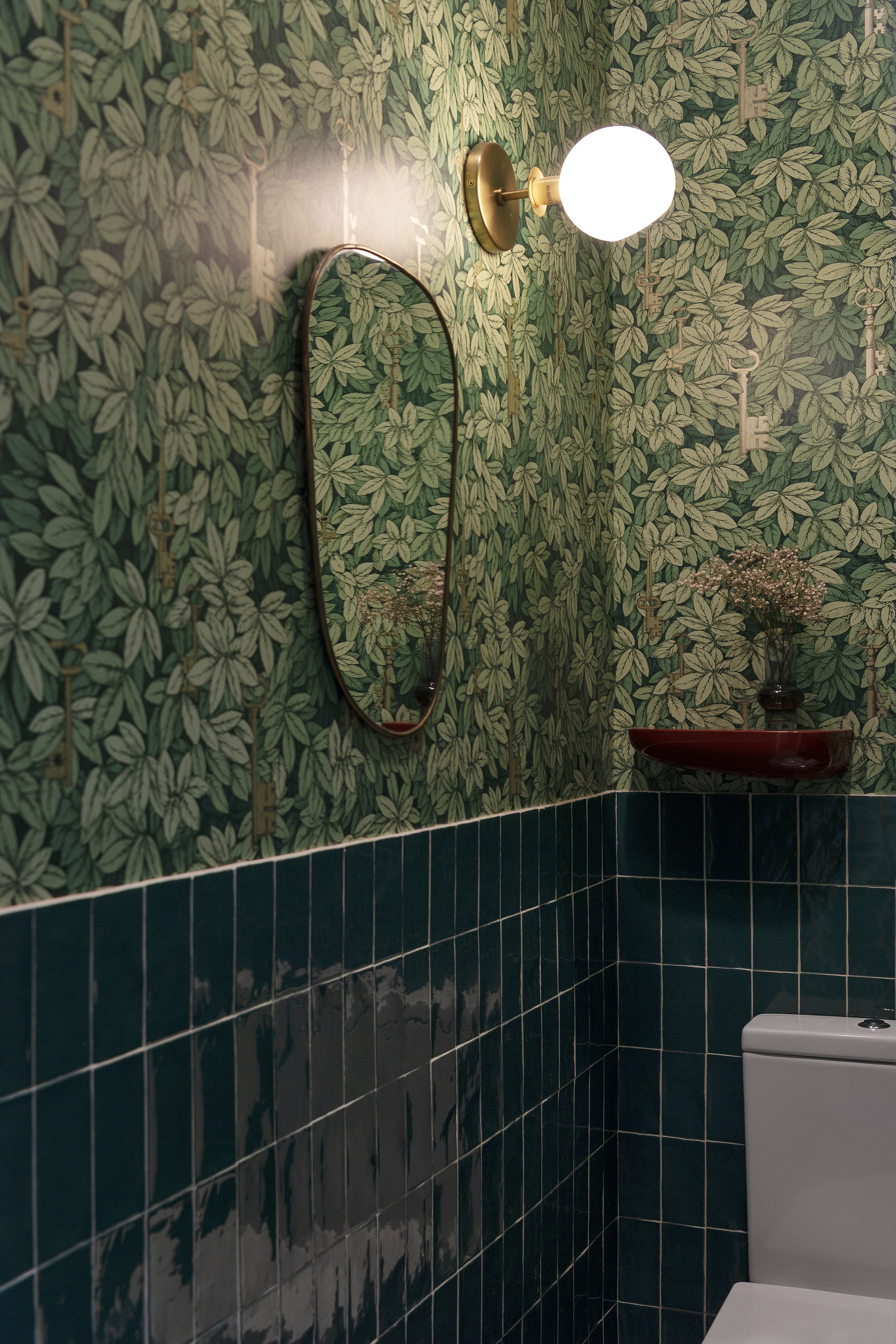
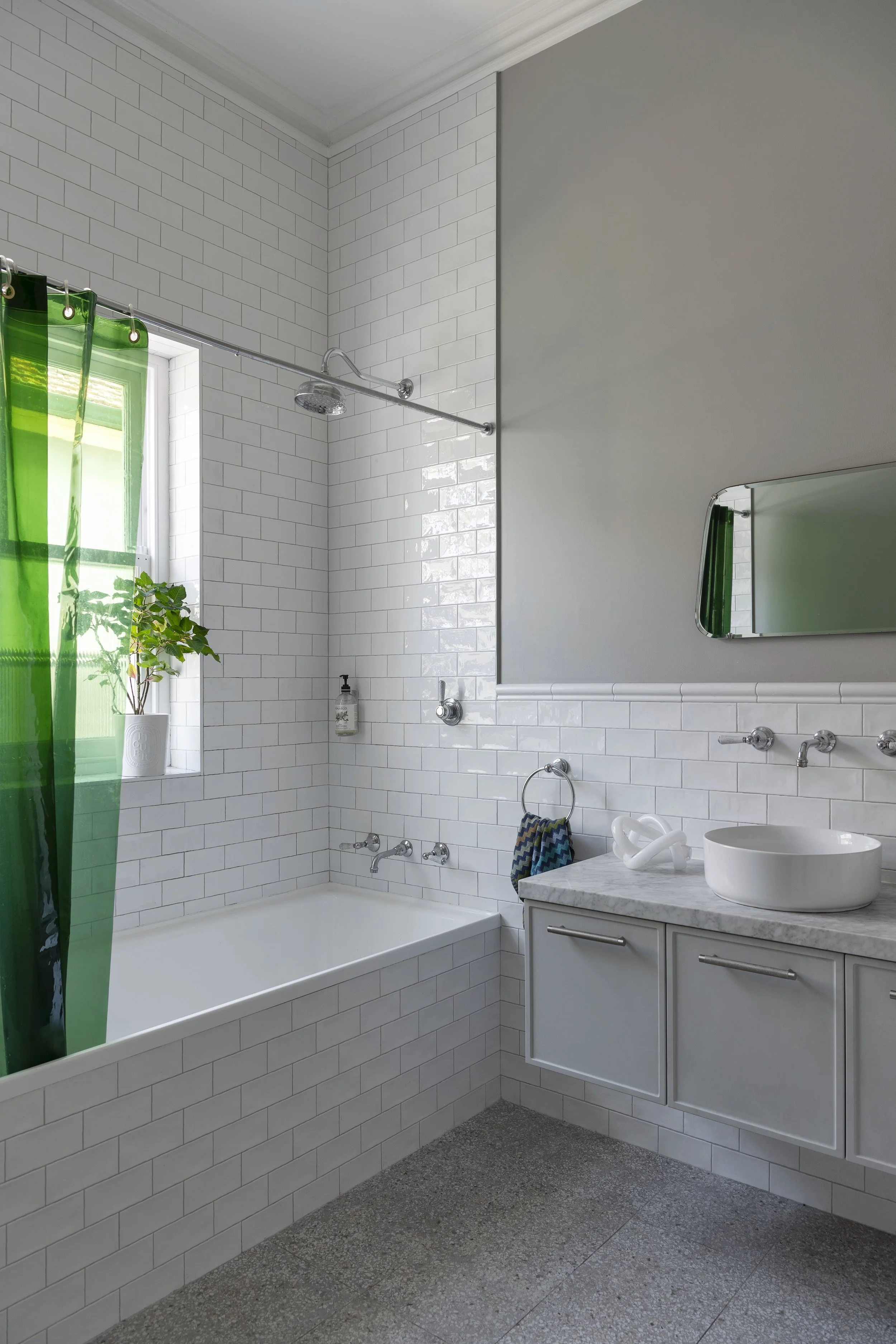
One of the rooms, a former lounge space, we transformed into a laundry, powder room and bathroom, a feat that meant cutting new openings through 30-centimetre-thick limestone walls. Terrazzo-style floors paid homage to the family before me, teamed with leafy Cole & Son wallpaper, subway tiles and bay-green cabinetry.
When builders demolished the lean-to, a hidden second slab was discovered half a metre below the first, throwing budgets into disarray. But the new extension, living, dining, kitchen and master suite brought light, space and a newness I hadn’t realised I’d craved. Our designer came up with a soaring ceiling punctuated by skylights, and I’ll never forget the sight of an enormous steel beam being craned over the old roofline, swaying gently before settling into place.
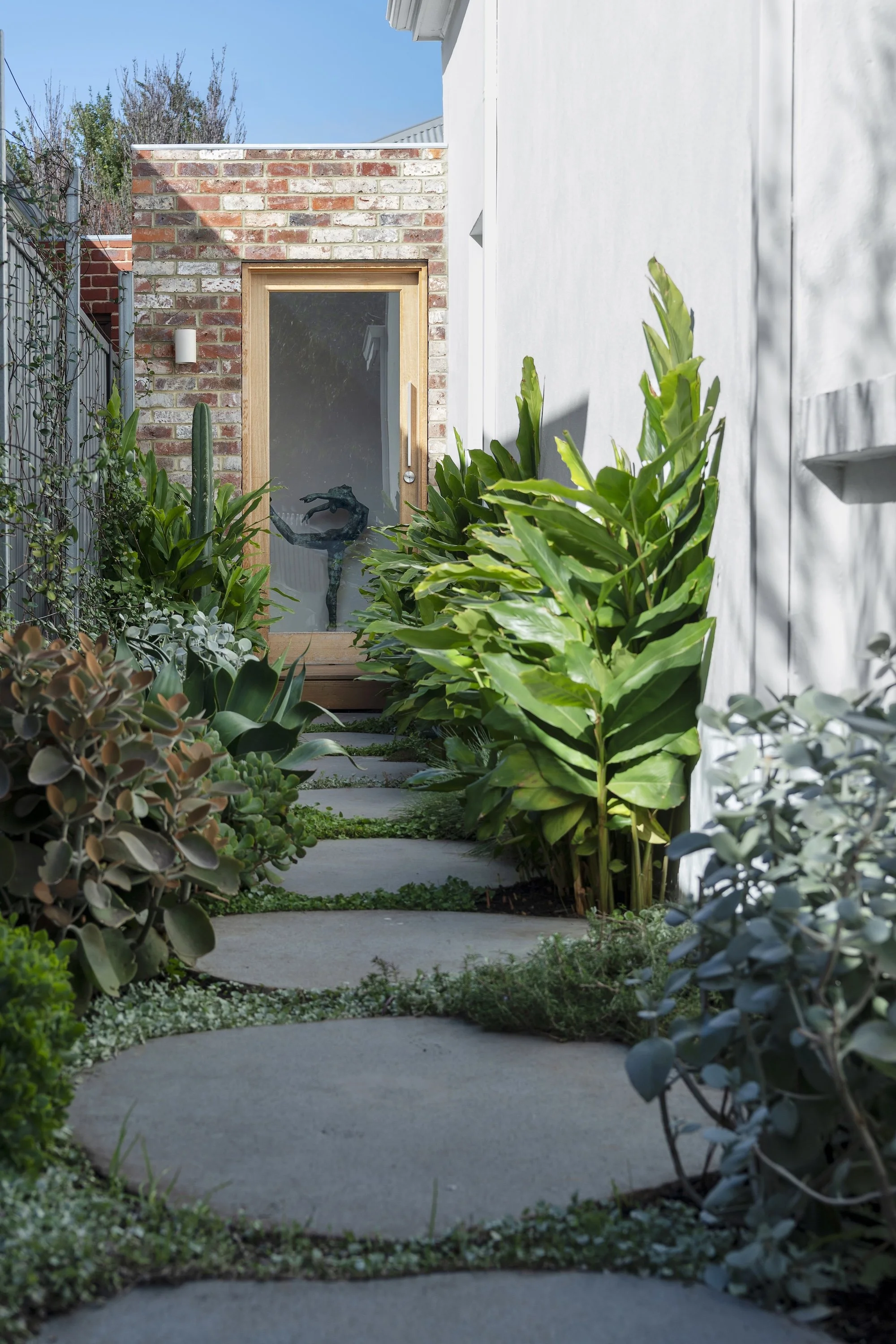
Custom French doors and louvred windows were designed to open to a deck shaded by bay trees. A polished concrete slab grounds the space, while a side door framed by reclaimed bricks adds texture and history. Sourcing and hauling materials ourselves was exhausting, but it gave the project its soul.
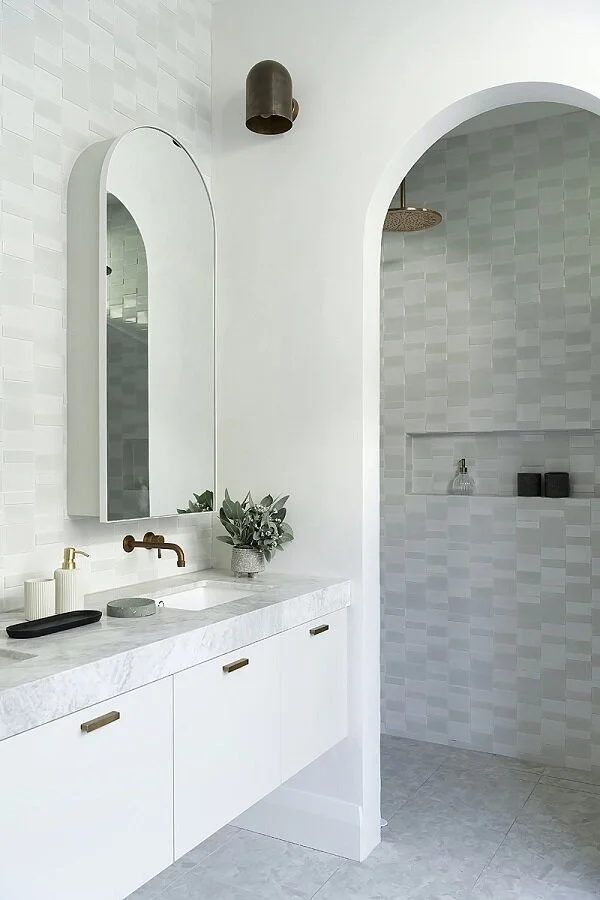
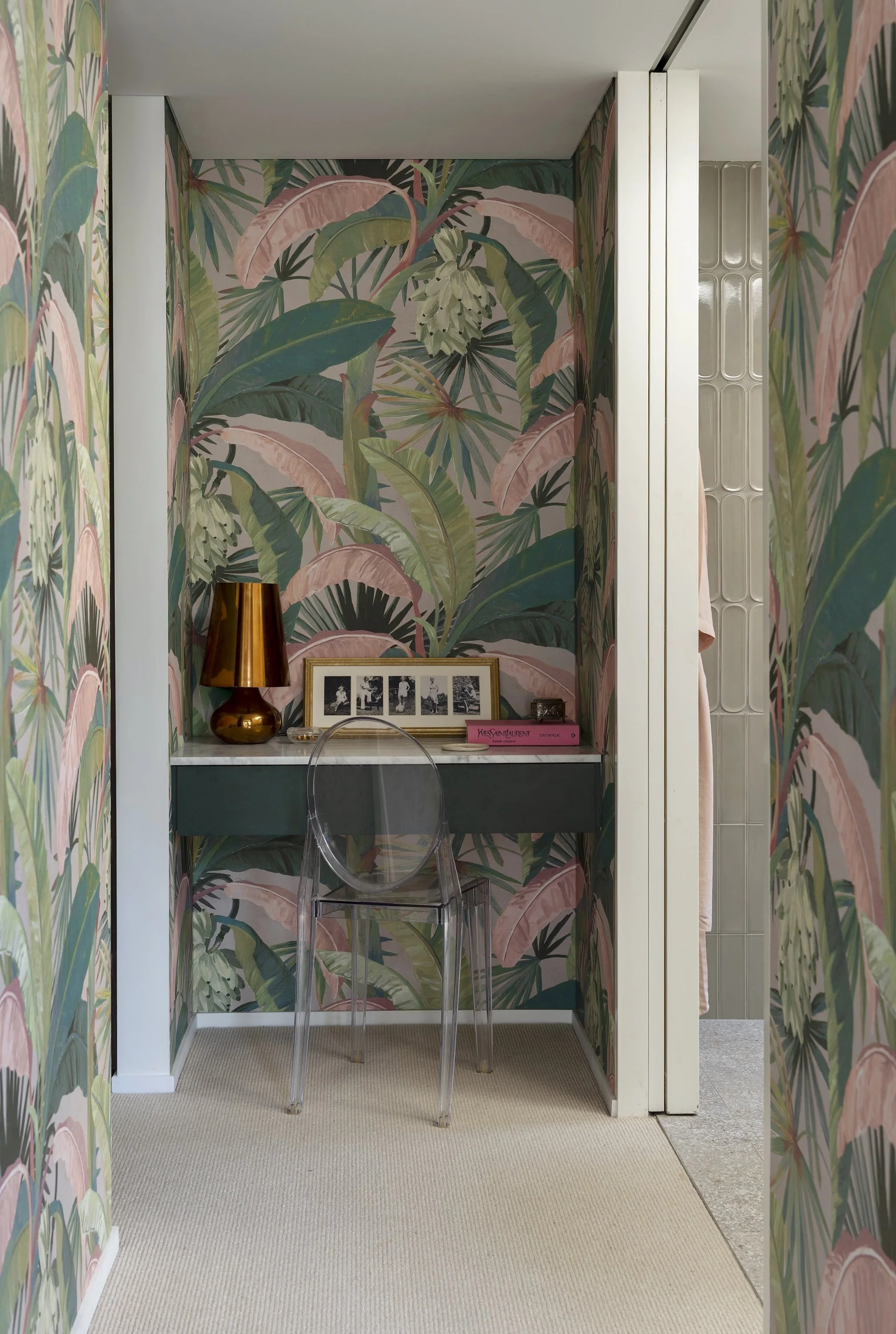
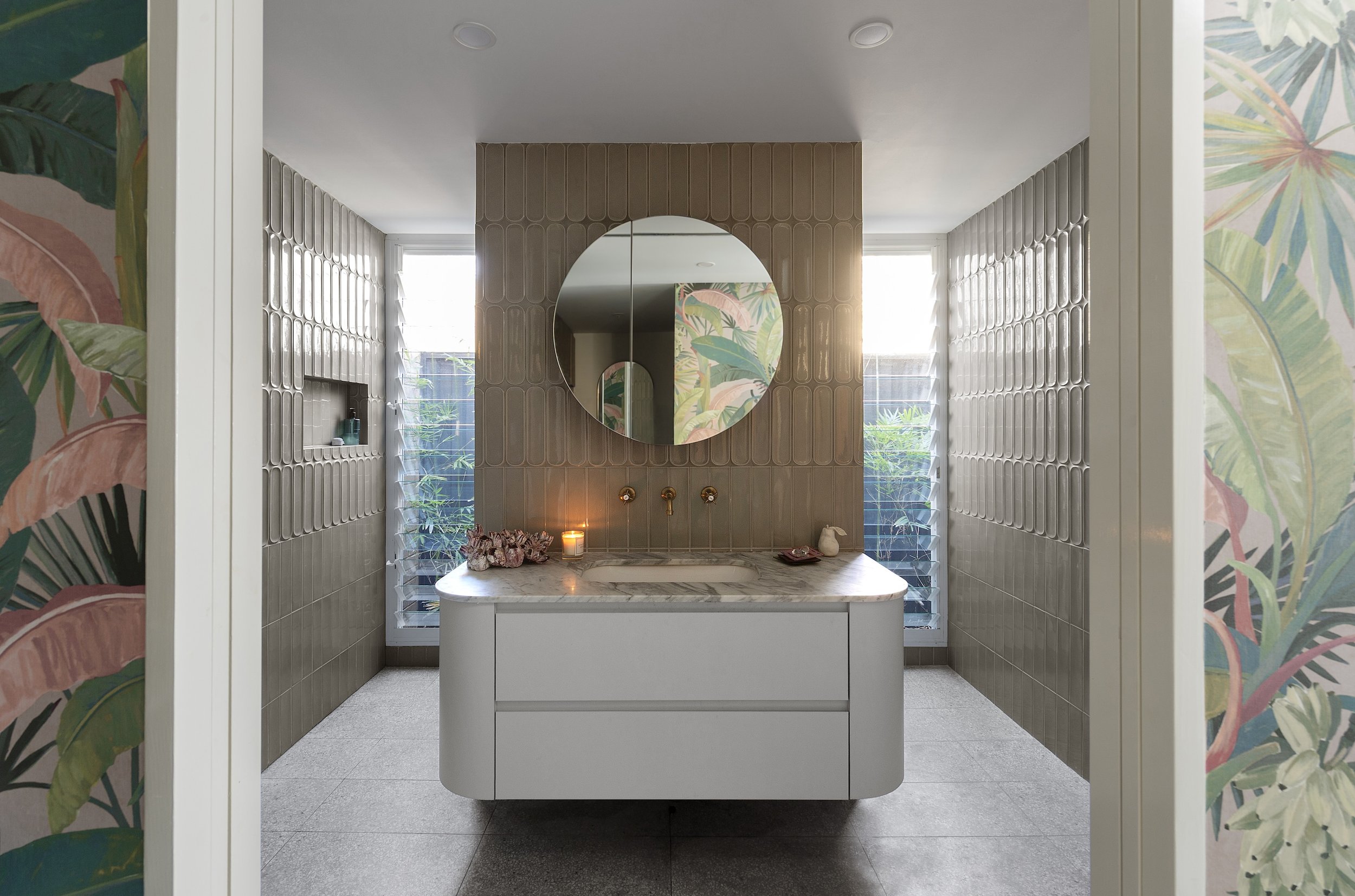
Inside, the new living space unfolds in calm layers of marble, timber and linen. In the master suite, I indulged in Catherine Martin wallpaper, billowing curtains and wool carpet. The compact ensuite demanded ingenuity: a central vanity conceals a shower on one side and a toilet on the other. Curved forms, sage-green tiles and a marble top, budget long forgotten, turned it into a small, sculptural jewel box.
I write about Australia’s most beautiful homes, so designing my own was both exciting and terrifying. Every tile, paint colour and fitting became a small existential decision. At times, I was paralysed by indecision and the quiet panic of making an expensive mistake. Interior designer Jane Ledger came by for coffee – and reassurance. As we walked through the rooms, I felt an enormous sense of relief knowing that what I’d imagined in my head would, in fact, translate.
The final chapter was the façade. I’d long resented the Roman columns, but budget constraints dictated they stay. Repainted and reframed by coastal landscaping – succulents, agaves, cacti and star jasmine by the team at Zerascapes – they suddenly made sense, part of the city’s eclectic vernacular.
Five years after buying my little limestone cottage, I sold it within a week. My next project is a nearby three-level modernist apartment, flooded with northern light, featuring sky-high ceilings, dramatic cutouts to the sky, and generous, airy spaces that invite bold colour, sculptural furniture, and contemporary accents. Again, I’m thinking of interiors like I think about fashion: statement pieces that catch the eye, tailored staples that anchor the space, and unexpected accents layered over hints of the past – because, as in style, the magic is in the mix.
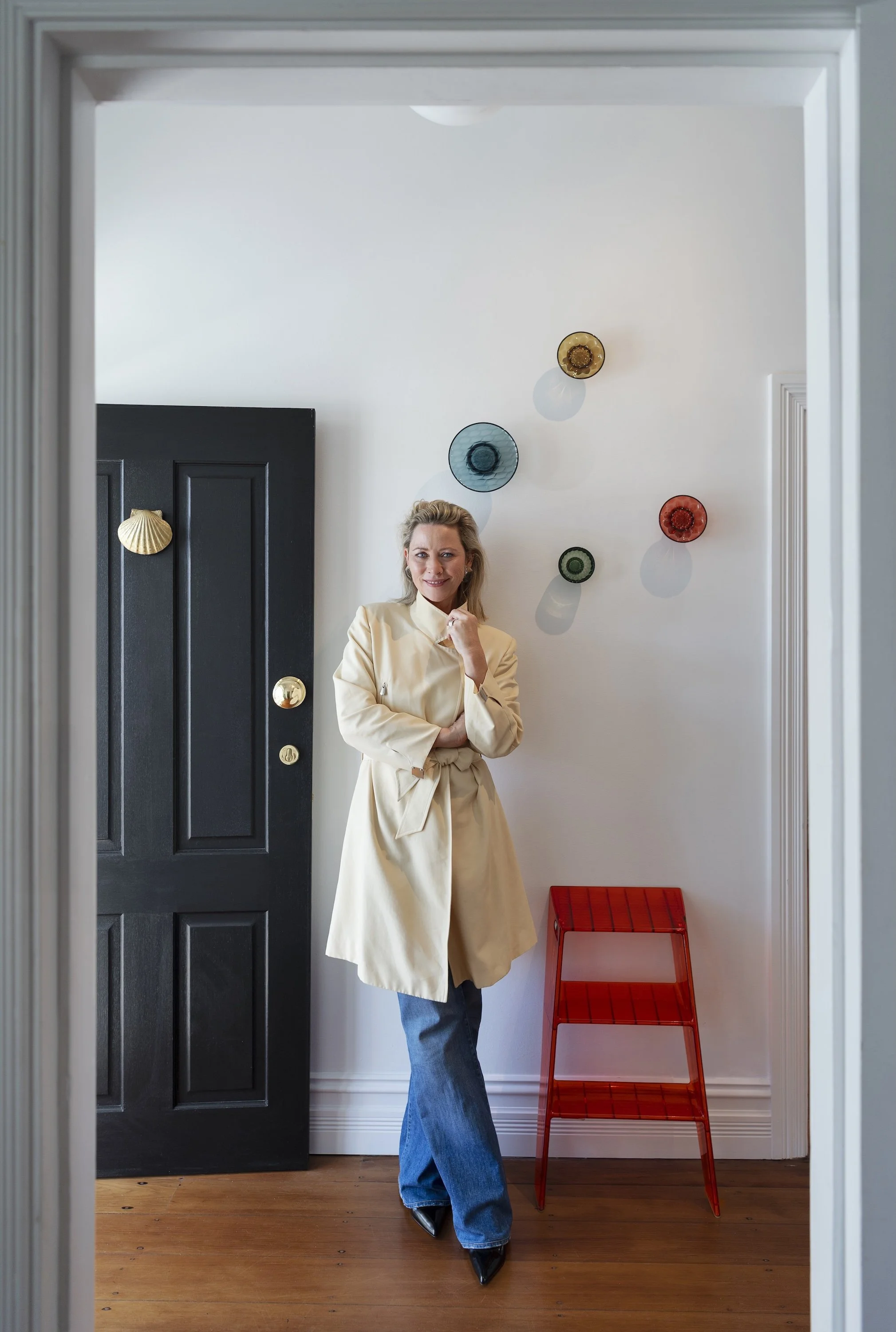
Elizabeth Clarke at home beside a Dulux Black Caviar front door, set in vintage glass with a brass seashell knocker by Sibella Court. Kartell’s Jellies Hangers and stepladder echo the home’s layered sculptural narrative.
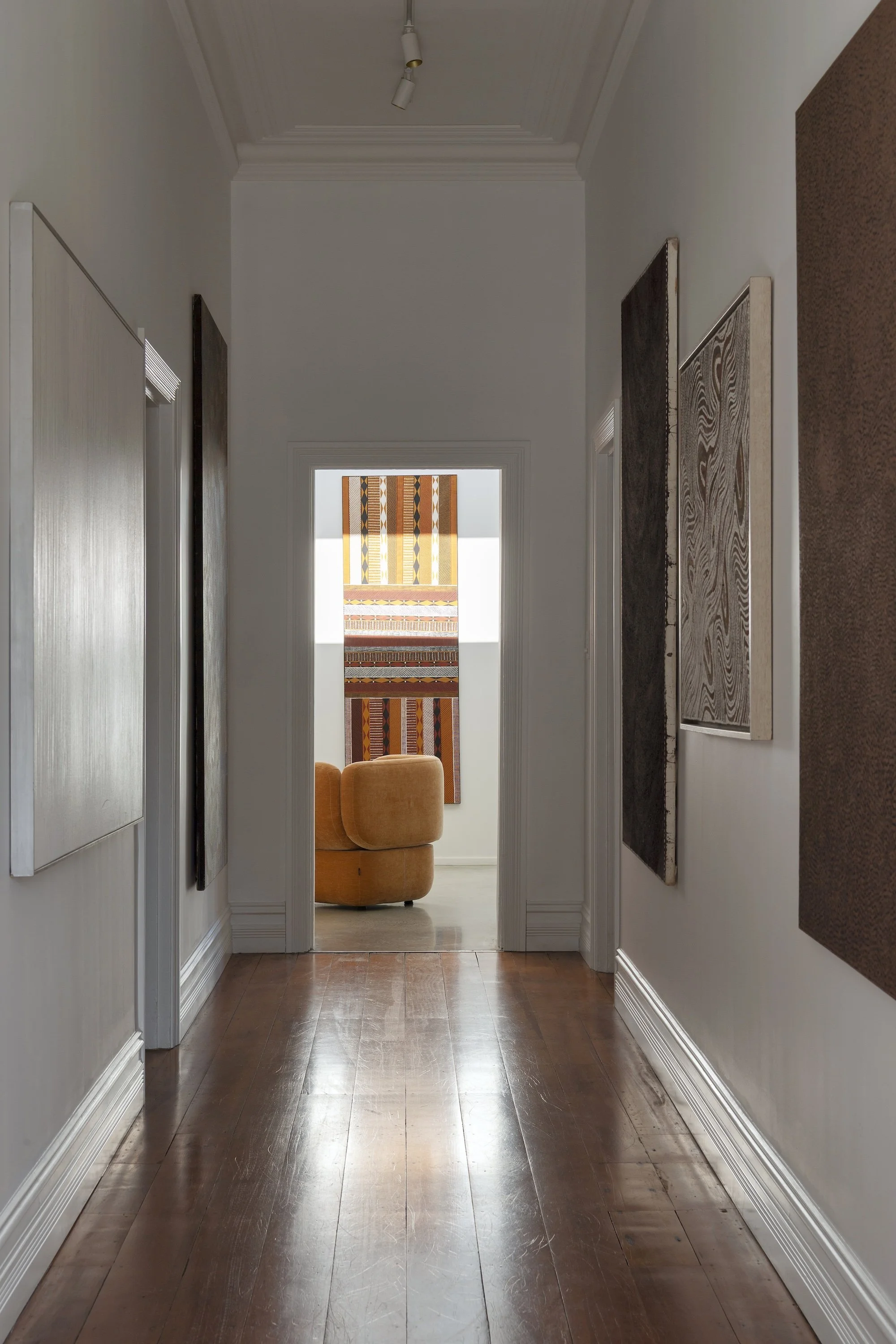
Gallery lighting by Alti Lighting transforms the corridor into a softly glowing art passage. The hallway displays art by indigenous artists including Aangkum –
Those People There (2001) by Rosella Namok on the left and on the right, Sing out Spring – Yiyili Country (2007) by David Cox, Bushfire series – Kulyayi Waterhole in the Great Sandy Desert (2006) by Lloyd Kwilla, and Untitled (2004) by Charlie Tjapangati. At the end of the hallway is Jilamara (2006) by Janice Murray. A Ditre Italia chair from Henri Living anchors the end of the hallway.
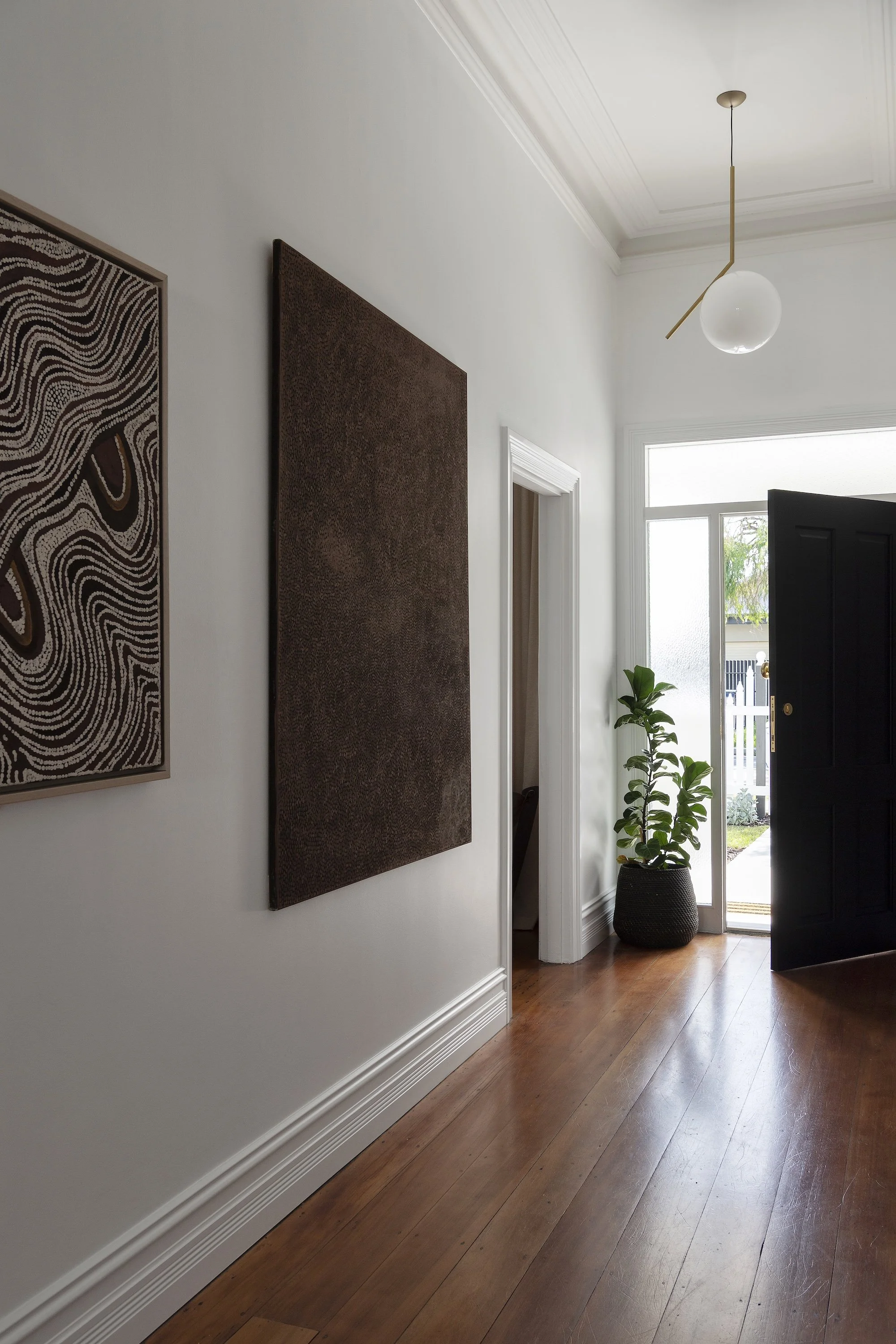
Looking back down the hallway, Lloyd Kwilla’s Bushfire Series – Kulyayi Waterhole in the Great Sandy Desert (2006), Charlie Tjapangati’s Untitled (2004) and the FLOS IC pendant from Living Edge guide the eye to the front entrance.
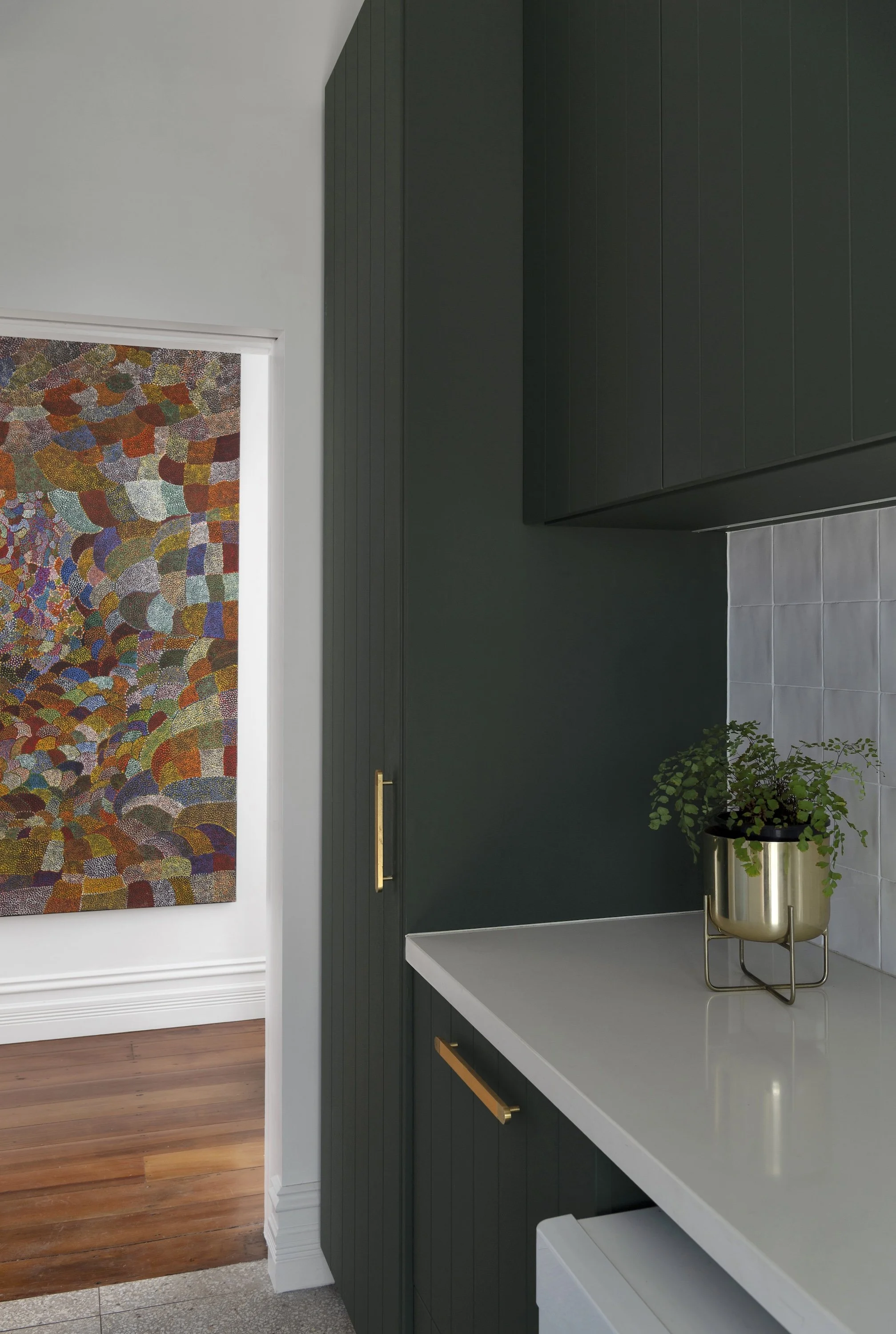
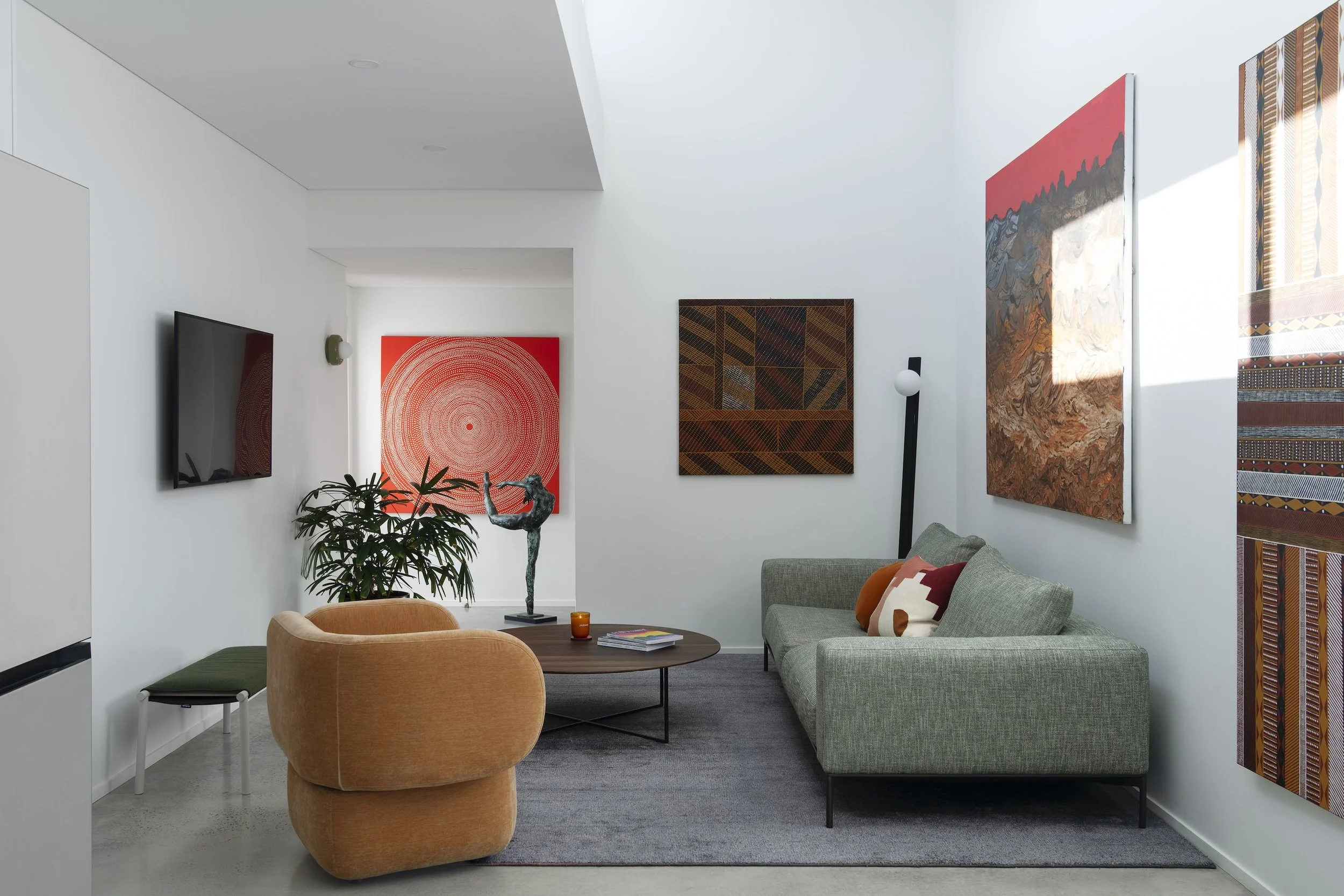
Angelina George’s My Imagined Country Series (2006) dominates one wall, paired with a bold Marimekko textile, artist Raymond Bush’s Untitled (2001) and Janice Murray’s Jilamara (2006). Sydney Harpley’s ballerina sculpture stands in dialogue with the Savoye sofa by Desiree, the Sabi coffee table, Bolzan’s Jack Padded Bench, Ditre Italia’s Vento chair, MIDJ Suspense lamp, and rug, all from Henri Living; the Nelly wall sconce is from Jardan.
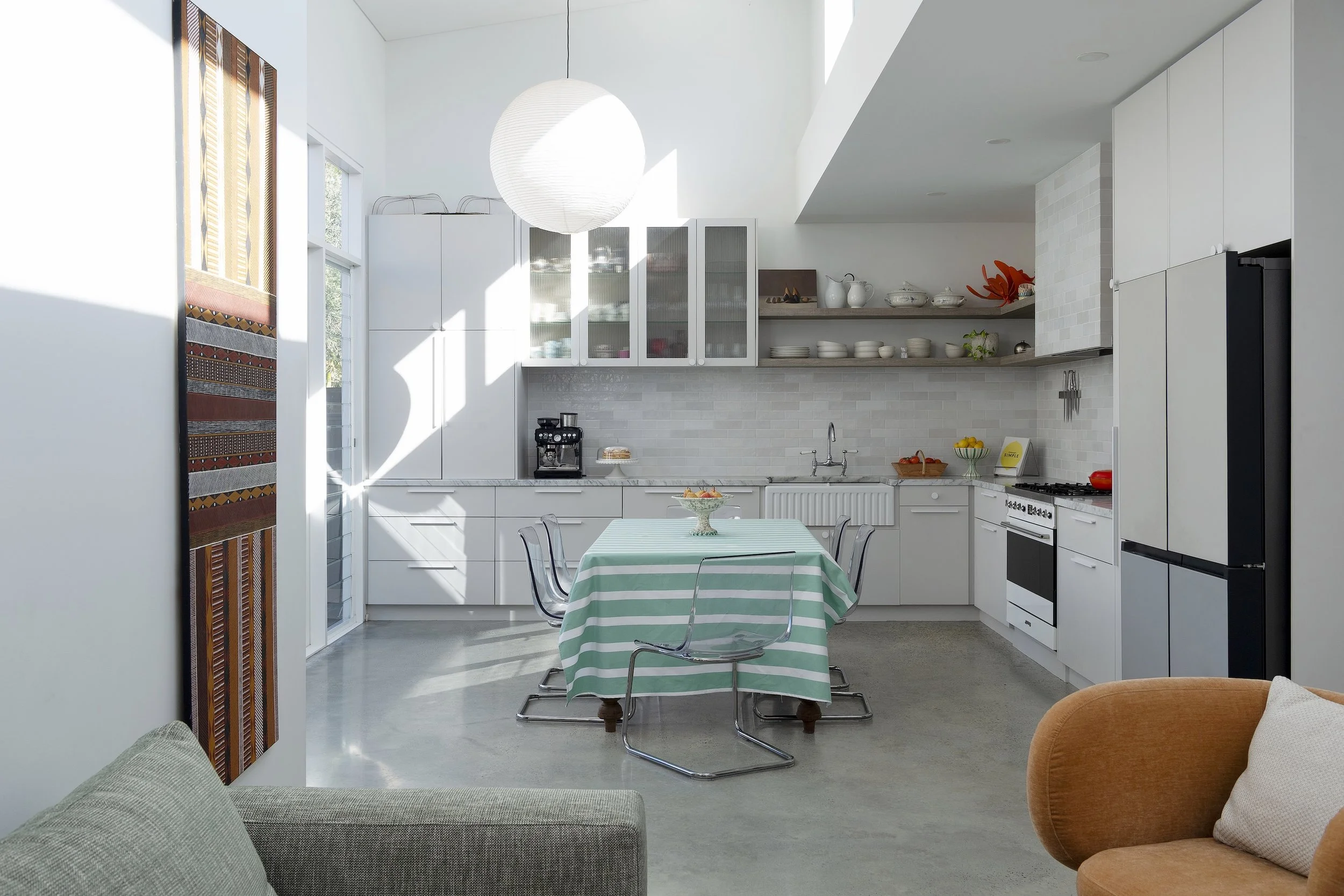
Custom Laminex Aries cabinetry and Delana Oak shelving frame tiles from Myaree Ceramics. Bianco Carrara Ombra marble from Zuccari flows across benchtops, paired with a Belfast fluted sink. Overhead, HAY’s Paper Pendant casts a gentle glow over polished concrete floors. Small details – a still life by Crispin Akerman, various ceramics by brands such as Alex and Trahanas – bring the kitchen to life.
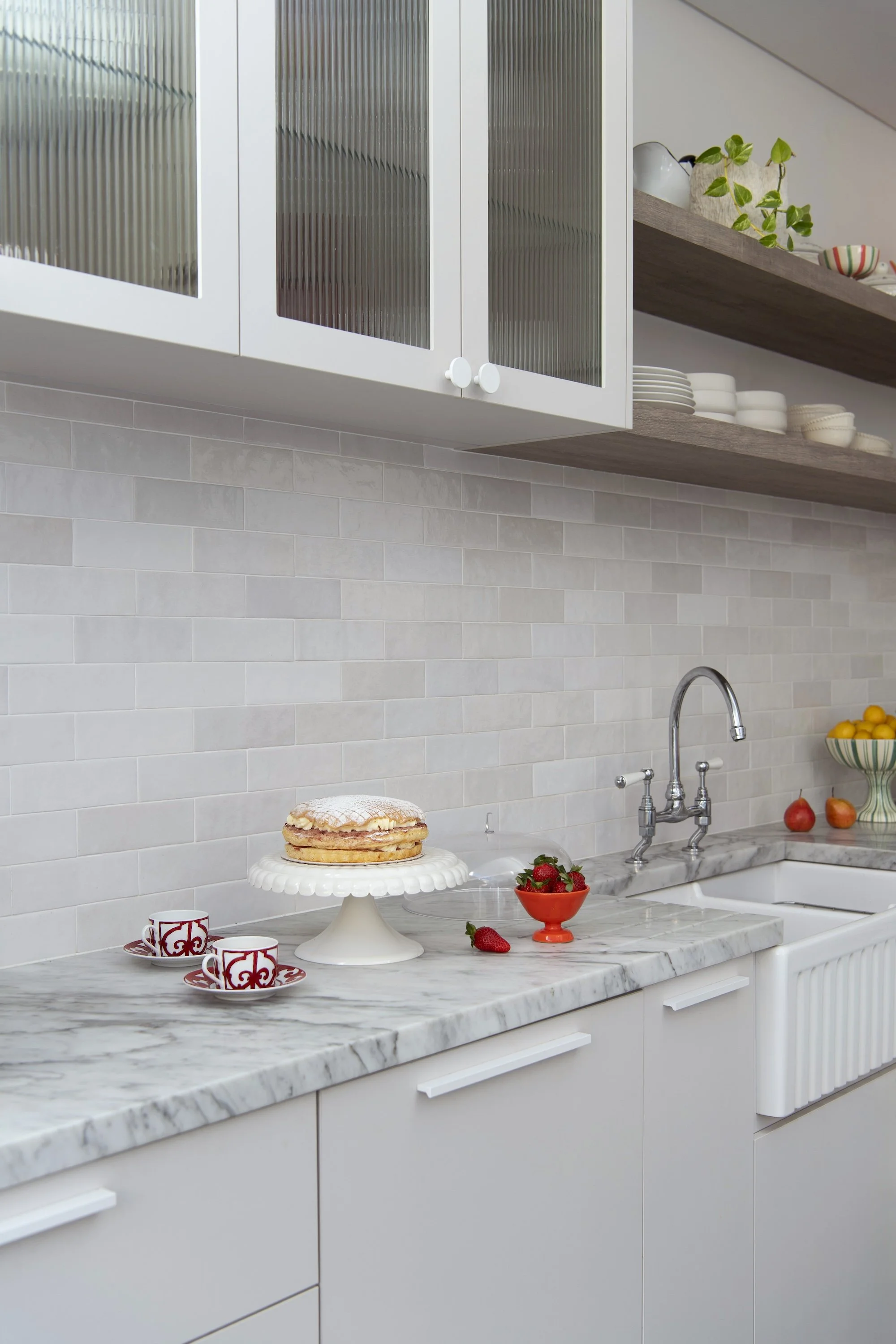
The kitchen benchtop in Bianco Carrara Ombra marble hosts curated tabletop objects: a cake stand from Empire Home, Hermès Balcon du Guadalquivir tea cups and saucers, and colourful ceramics by Alex and Trahanas. The white cabinet handles are from Linear Standard.
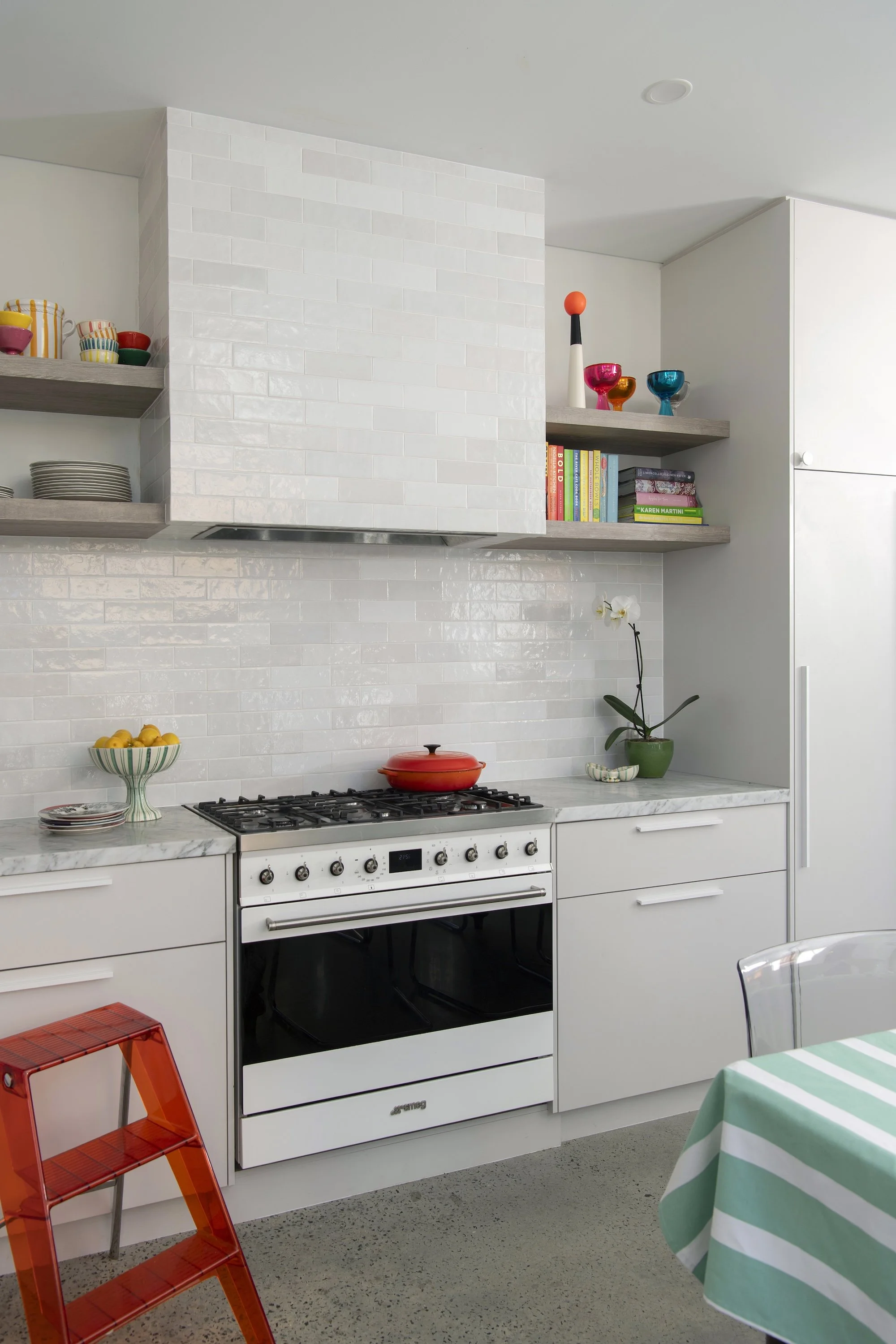
A SMEG Classic cooker anchors the kitchen and colourful accessories including a Tom Dixon peppermill, ceramics and cookbooks add vibrancy to the space.
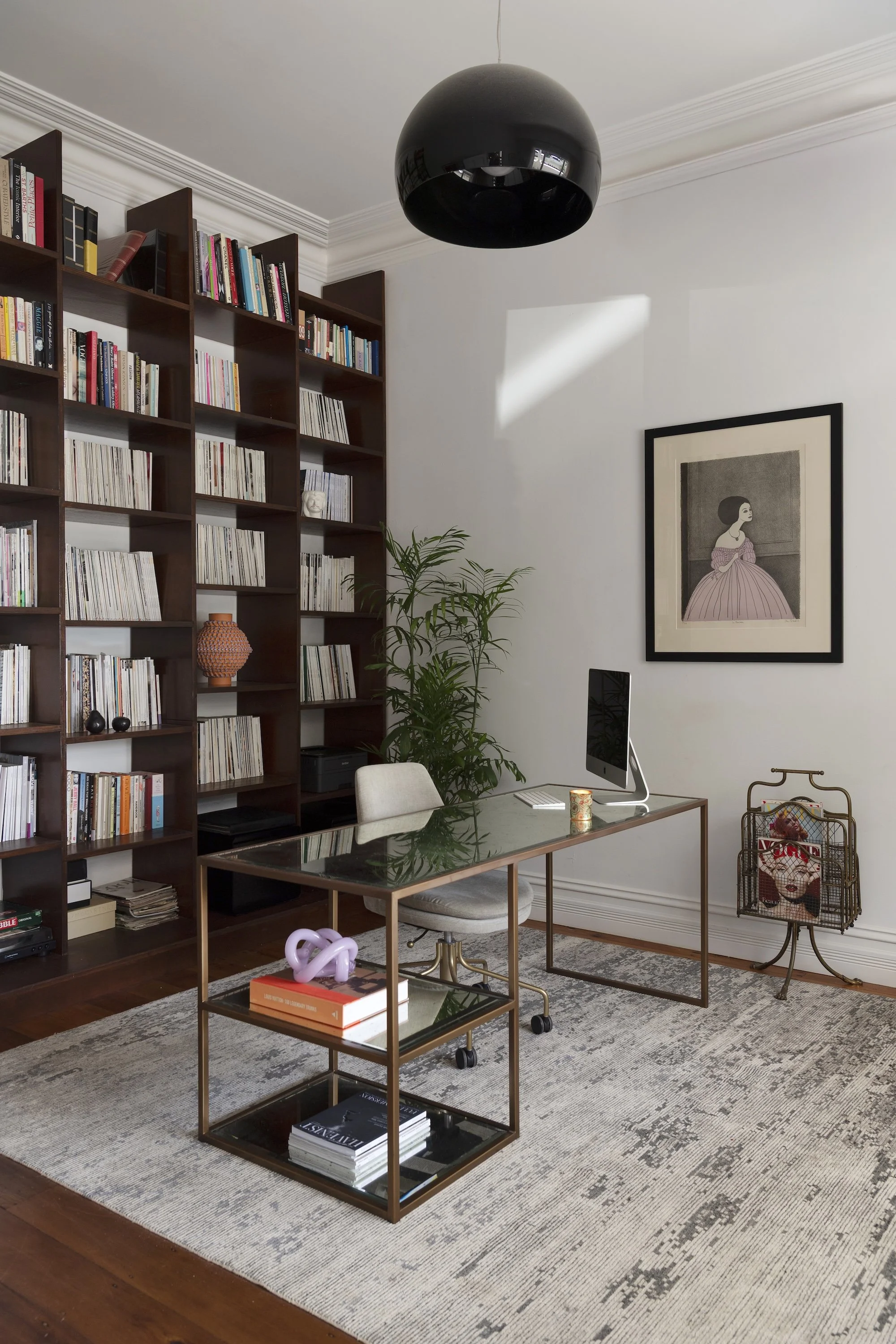
Elegant simplicity defines the office: a black Kartell FL/Y pendant hovers above a mirrored desk from Coco Republic. Custom recycled jarrah shelving rises floor-to-ceiling, referencing Fremantle’s industrial past. The rug is from Henri Living, the glass sculpture from Jardan and the limited-print La Traviata is by John Brack.
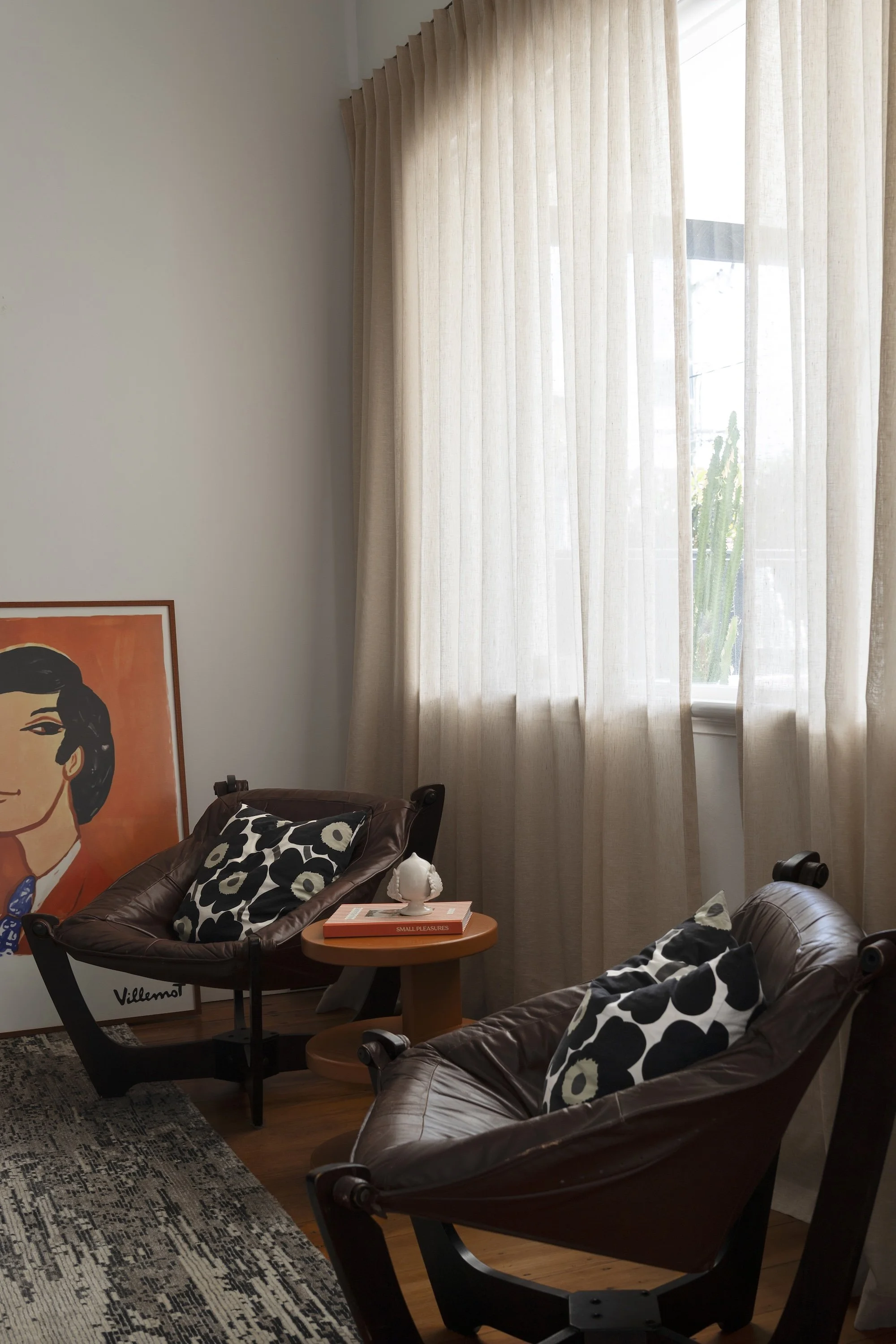
Custom linen curtains by Window Studio filter soft light over a pair of vintage leather chairs, Marimekko cushions, and a Kitt side table by Jardan. The poster, Orange Man by Bernard Villemot, adds a quirky flourish.
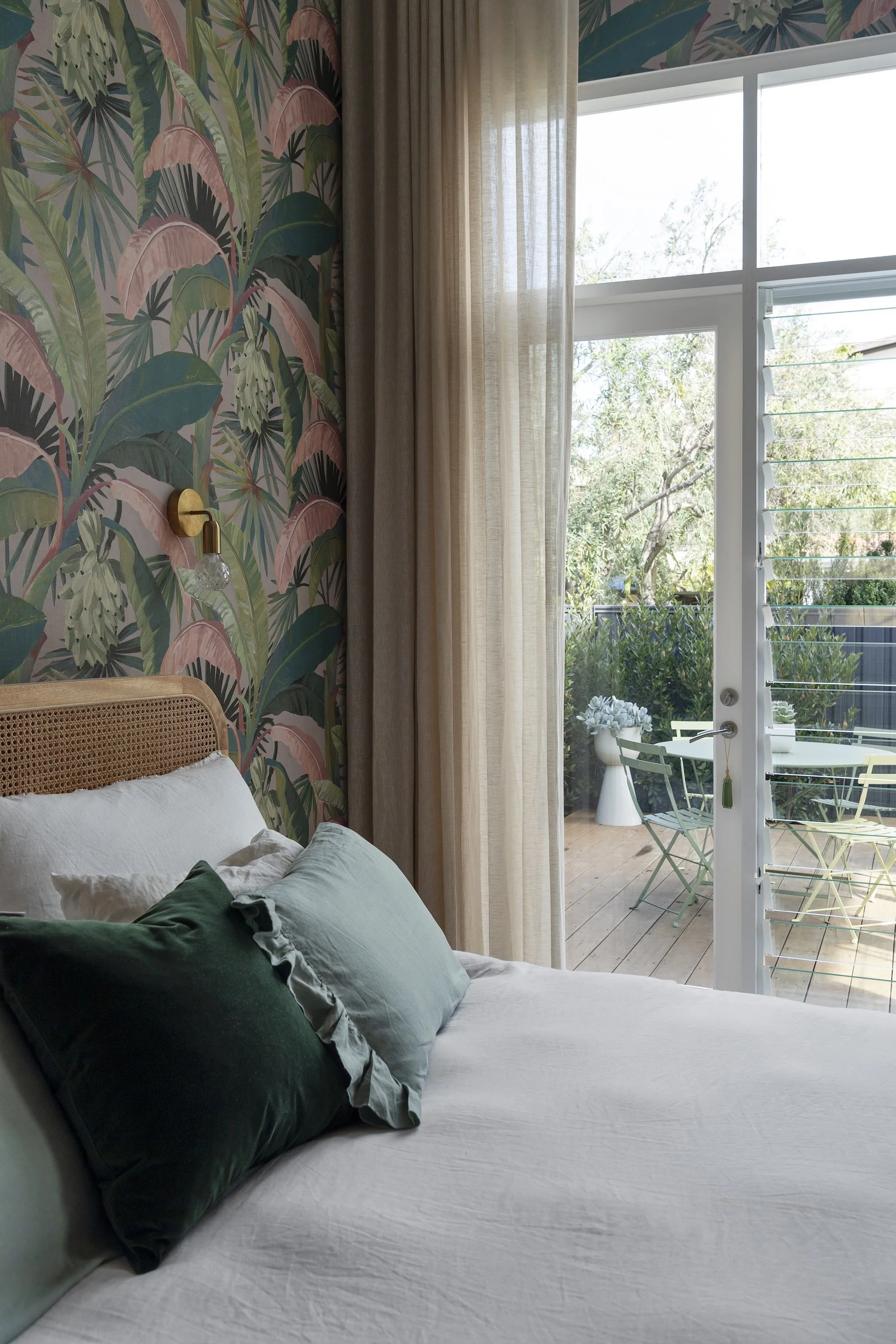
Master suite serenity: Mokum La Palma wallpaper by Catherine Martin envelopes the room, complemented by linen mix curtains by Window Studio and Lee Broom Crystal Bulb wall lights. Bedlinen from Bed Threads, a ruffled linen GlamSwag pillowcase, and Empire Home Willow bed complete the restful scheme. Outside, a Fermob table setting by Patio & Balcony Outdoor Living and a tall planter by Lightly draw the outside in. The custom door is by Kohlen Joinery.
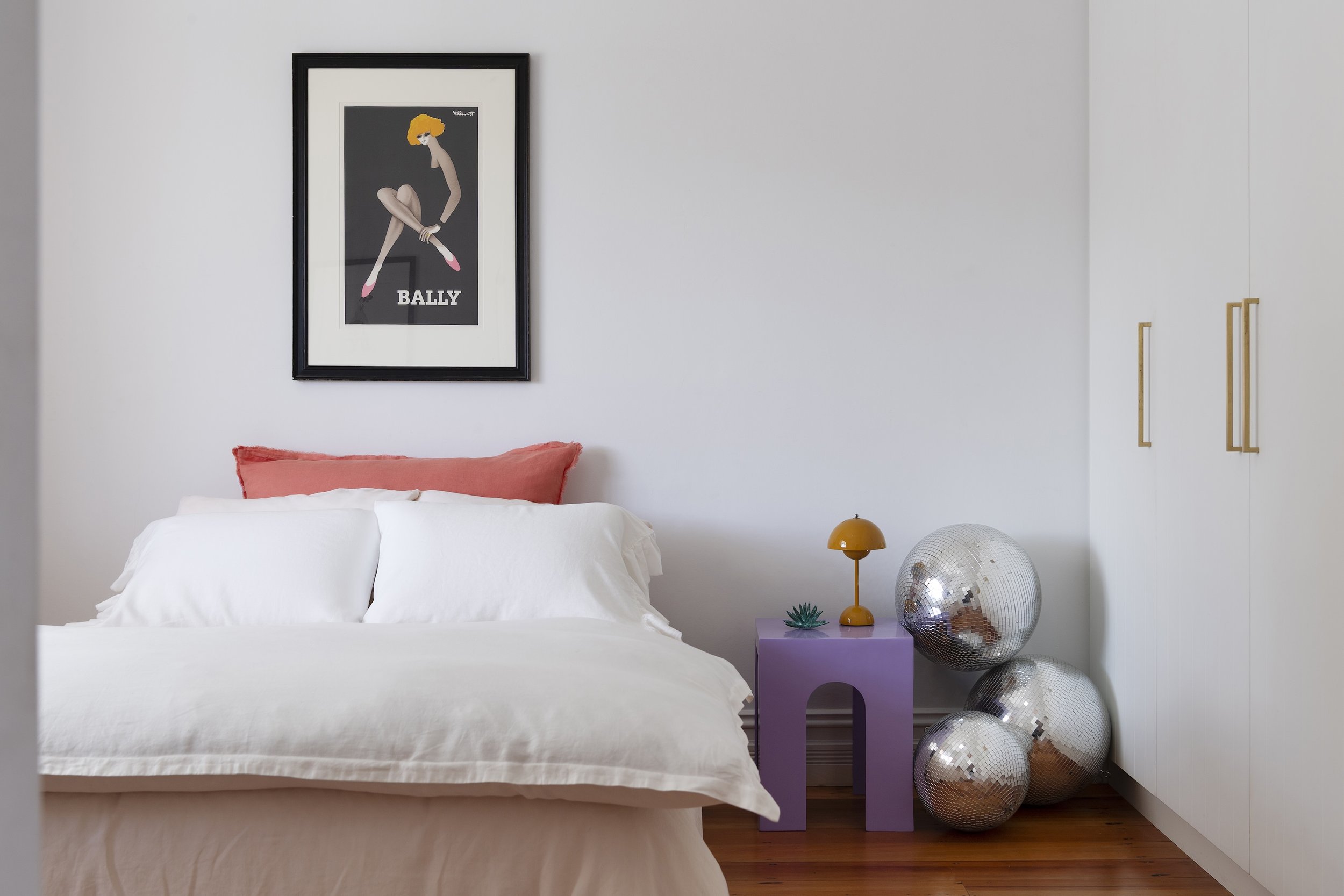
In Elizabeth’s daughter Bella’s bedroom, the Gè Suspension pendant light by Kartell and Bonlex V-groove cabinetry introduce a contemporary touch. The original Bally print was discovered in a vintage poster store in Maui. The bedlinen is from Bed Threads, the Bedhead Cushion, GlamSwag and linen pillowcases are from GlamSwag. The &Tradition table lamp is from Cult Design, the side table from Lightly and the mirror balls from Empire Home.
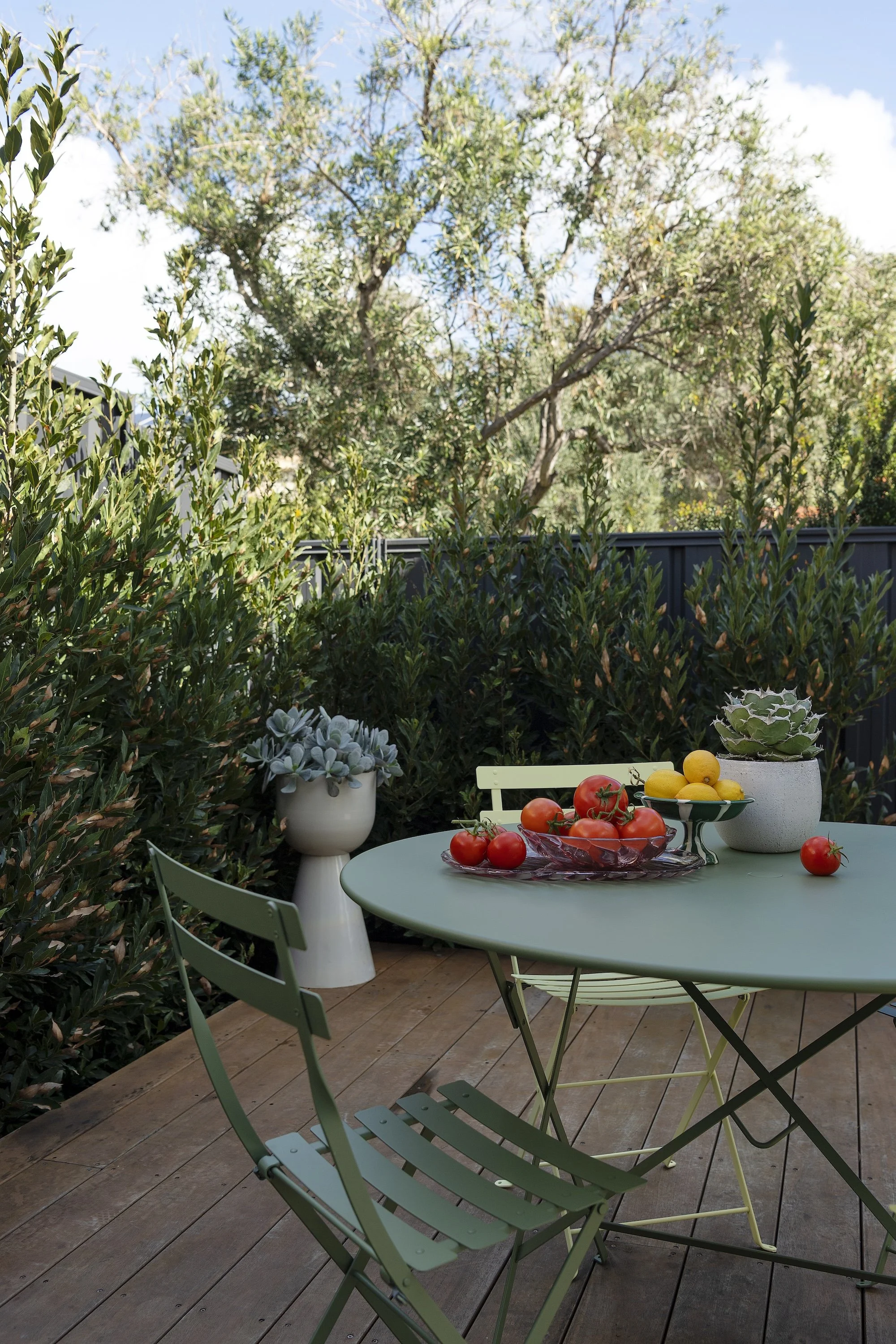
Soft greenery and sculptural simplicity define the back deck. The Fermob Bistro table and chairs are from Patio Balcony Outdoor Living, the planter is by Lightly and the potted succulents and landscaping by Zerascapes.
“I write about Australia’s most beautiful homes, so designing my own was both exciting and terrifying.”
—ELIZABETH CLARKE
Tour more havens